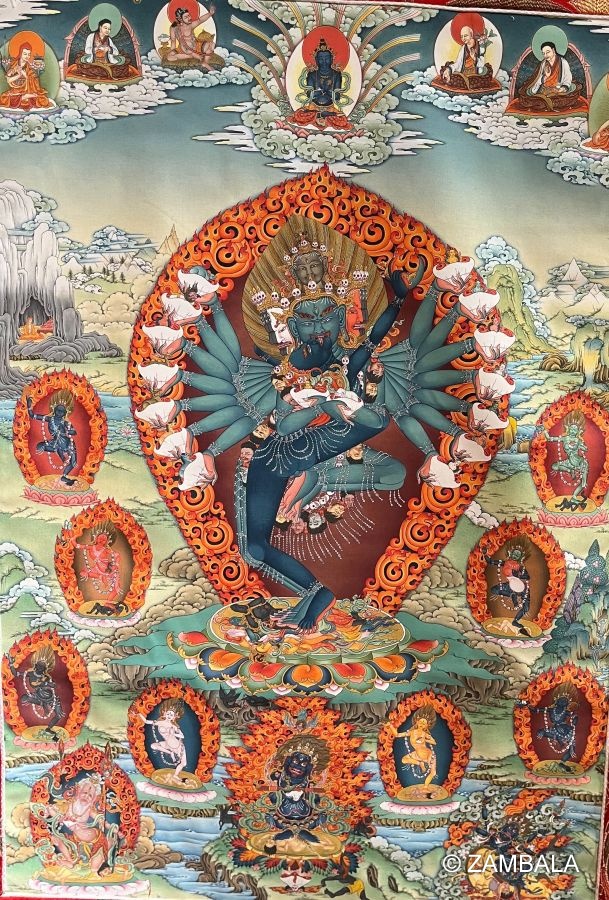
Material: Cloth. Printing. Scroll. (Heruka)
Size: Approximately 122 x 83 cm
Description:
The main deity depicted in this thangka is a very important wrathful deity in the Tibetan Buddhist tantras, named Heruka (Tibetan: བདེ་བ་དང་ལྡན་པ།, transliterated: Deva Chinpa; Sanskrit: \*\*Śrī Cakrasaṃvara or **Śrī Heruka)**
Feature identification:
1. **The main deity is dark blue or dark blue, with four faces and twelve arms (some versions have 24 arms)**, and embraces the consort in union, symbolizing the unity of emptiness and bliss.
2. **Wearing a skull crown and a skull rosary**, it represents the power to destroy ego and reincarnation.
3. **Holding instruments such as vajra, bell, axe, hook, wheel, etc.**, it represents the wisdom and convenience of eliminating troubles and subduing internal and external demonic obstacles.
4. **Stepping on the male and female bodies**, it symbolizes the subjugation of the three poisons of greed, anger and ignorance and worldly attachment.
5. **The blazing flame of wisdom behind it**, symbolizes the burning of ignorance.
Explanation of the surrounding deities:
* **In the clouds above the center, there are Sakyamuni Buddha and successive masters (possibly the great accomplished masters Padmasambhava, Tilopa, Naropa, etc.)**, symbolizing the inheritance of the Dharma lineage.
* **The wrathful deities and their dakini followers surrounding them** are the gods in the Vajra Mandala (such as dakini, Dharma protectors, ten wrathful deities, etc.), each of which has its own symbolic meaning and function.
* **The black deity in the center** is Mahakala (Tibetan: ནག་པོ་ཆེན་པོ།, Mahākāla), an important guardian deity.
The religious significance of Heruka:
* It is one of the top deities in the Anuttarayoga Tantra**.
* It is especially important in the Sakya, Gelug, and Kagyu sects**, and Heruka tantra is one of the main practices of these sects.
* Its practice can** quickly purify karma, realize emptiness and bliss, and directly point to the path of attainment of becoming a Buddha in this life. **
Supplement:
* If this thangka is used for practice, it is usually accompanied by a complete Heruka empowerment and oral transmission.
* Heruka also has different traditions, such as the "Six Dharmas of Naropa", which includes related practice methods.
(printed thangka with cloth frame)
|
|